
So, you're thinking about starting an internet radio station? It's an exciting idea, and it's more achievable today than ever before. The core of it comes down to a few key things: figuring out your station's unique vibe, sorting out the music licenses, grabbing some essential gear and software, and finding a solid streaming host.
But the real secret to success in today's streaming world? Consistency. That's why building a 24/7 live stream on a platform like YouTube is one of the smartest moves you can make. It creates a constant presence that helps you build a loyal audience right from the start, which is the ultimate goal.
Your Launchpad for an Internet Radio Station
Running an internet radio station used to be a pipe dream for most, but not anymore. Forget needing massive, expensive transmitters or a soundproofed studio. These days, all it really takes is a good idea, a computer you probably already own, and a genuine passion for sharing music or talk with the world.
This guide is your roadmap. We’ll walk through everything you need to know, from that first spark of an idea to getting your station live and broadcasting. We're going to approach this from a modern perspective, focusing on how to set up a continuous 24/7 live stream. It’s an incredibly effective way to get noticed on platforms like YouTube, where content that's always on gets a serious boost in visibility and helps grow your community faster.
Why Now Is the Perfect Time
It's not just that broadcasting is easier—the audience is bigger than ever. The global internet radio market is on track to hit around $15.6 billion in 2025. Even more impressive, it's expected to keep growing at a rate of 12.5% every year through 2033. This boom is happening because people are ditching traditional radio for personalized content they can get on their phones and smart speakers. If you're curious, you can explore the full market research about this trend to see the numbers for yourself.
What does this mean for you? A huge opportunity. Listeners are actively searching for unique, curated experiences that algorithms on big streaming services can't deliver. They want that human touch—a real person or a well-programmed 24/7 stream that introduces them to something new.
A successful station isn't just about playing music; it's about building a community. By broadcasting 24/7, you create a constant, reliable space where your audience can always tune in, fostering loyalty and a sense of belonging. This is particularly powerful on platforms like YouTube where continuous streams thrive.
What This Guide Will Cover
This isn't just a basic checklist. We're going to dive deep into the practical steps you need to not only launch your station but also make it last as a continuous broadcast. We'll cover the entire journey, making sure you have a rock-solid plan.
Here’s a sneak peek at what’s ahead:
- Defining Your Niche: We'll figure out how to pinpoint a unique concept that will draw in a dedicated crowd for your 24/7 stream.
- Legal Essentials: I'll help you navigate the tricky world of music licensing so your station stays above board.
- Technical Setup: We'll go over the right hardware, software, and hosting to keep your 24/7 broadcast running smoothly.
- Going Live: You'll learn how to configure your stream for platforms like YouTube and get your sound out to a global audience.
- Growth and Monetization: We'll explore real strategies for promoting your station and turning it into a sustainable project.
By the time you're done here, you’ll have a clear, actionable plan to start an internet radio station that's built for today's listener and optimized for 24/7 streaming.
Laying the Groundwork: Your Station's Identity and Plan
Before you even think about microphones or music libraries, the real work begins. A great internet radio station doesn't just happen; it’s built on a solid plan. This is the part where your cool idea transforms into a real, tangible concept that can actually find and keep an audience for a 24/7 broadcast.
Your station needs a distinct personality. In a sea of infinite listening choices, generic stations are easily forgotten. The secret is to find a specific niche you can truly dominate. Don't just think in broad strokes like "rock" or "talk." You have to drill down.
For instance, instead of another "80s music" station, you could become the definitive home for 80s J-pop and city pop deep cuts. Instead of a general "gaming music" stream, why not create a 24/7 broadcast of retro RPG soundtracks for people who want to focus or feel a bit nostalgic? A sharp focus like this makes you memorable and helps build a loyal community around a shared passion.
Who Are You Really Talking To?
Every single decision you make—from the music you play to the way you talk on air—should be for a specific person. If you try to broadcast for everyone, you end up connecting with no one. Building a detailed "listener persona" is your roadmap for content, tone, and even how you promote your station.
Ask yourself a few key questions to sketch out this ideal listener:
- The Basics: What's their age, general location, and what do they do for a living?
- Their World: What are their hobbies? What other podcasts, shows, or music do they love?
- Their Routine: When are they tuning in? Is it during the morning commute, at their desk during the workday, or late at night?
- The "Why": What are they looking for that they can't get anywhere else? Is it discovering new music, feeling part of a community, or hearing expert commentary?
Knowing these details helps you create a station that feels personal, like it was made just for them. This is absolutely critical for a 24/7 live stream, because you can schedule your content—like a high-energy morning block or a chill evening playlist—to fit perfectly into their daily life.
Creating a Brand That Sticks
Your brand is so much more than a name and a logo. It’s the entire vibe. It's how your station looks, sounds, and makes people feel. A strong brand creates an immediate connection and makes you instantly recognizable.
Nailing the Name
Your station's name is your handshake. It needs to be easy to remember, simple to spell, and give a hint about your content. Try brainstorming words connected to your niche. If you’re creating a 24/7 stream of calm ambient music, a name like "Static Flow Radio" or "The Chillout Zone" just works better than something generic.
Designing a Simple, Effective Logo
Think of your logo as your visual signature. You don’t need some over-the-top, complex design. In fact, a clean, simple logo that looks great even when it’s tiny (like on a YouTube stream overlay or a social media profile) is usually the most powerful. It should visually echo your station's personality, whether that’s modern and minimalist or vibrant and retro.
Don't forget your "sonic identity"—this is just as important. We're talking about the jingles, sweepers, and intros that make your station sound polished and professional. A consistent audio signature lets listeners know exactly where they are the second they tune into your 24/7 stream.
Mapping Out Your 24/7 Programming
With your niche defined and your brand taking shape, it's time to think about what you'll actually broadcast. For a 24/7 stream, a content calendar is your best friend for keeping things fresh and preventing listener fatigue. Start by sketching out different show ideas or themed blocks.
- Music Blocks: Curate playlists for different parts of the day. Think "Morning Motivation Mix" or "Late Night Lo-Fi." This is the core of most 24/7 music streams on YouTube.
- Talk Segments: If your station has talk, plan it out. This could be interviews, news updates, or discussions relevant to your listeners.
- Specialty Shows: Carve out a weekly slot for a deep dive into a sub-genre, an artist spotlight, or even a guest DJ set.
- Get Listeners Involved: Schedule things like request hours or themed call-in segments. It’s a fantastic way to build a real community around your continuous stream.
By mapping out your content week by week, you create a dynamic and varied experience that gives people a reason to keep coming back. Honestly, this planning phase is the most important part of learning how to start an internet radio station that doesn't just launch, but actually lasts as a 24/7 broadcast.
Getting the Music Licensing and Legal Stuff Right

Alright, let's talk about the part that makes a lot of new broadcasters nervous: music licensing. It can feel like a maze, but getting this right from the start is non-negotiable. If you want to play the hits and build a station that lasts, you have to play by the rules.
Think of it this way—every time you stream a song, you're giving a public performance. The artists, songwriters, and producers behind that track deserve to be paid for their work. Licensing is simply the system that makes sure that happens. Ignoring it can bring takedown notices, platform bans, or legal trouble that will sink your 24/7 stream before it even sets sail.
This isn't a niche concern. The U.S. internet radio market is massive, projected to hit $3.6 billion in revenue by 2025, with around 3,390 businesses in the game. That kind of established industry has very clear rules. You can explore more insights on the U.S. internet radio industry to get a sense of the scale we're talking about.
Who Are the PROs and Why Do They Matter?
So, how do you pay the artists? You don't send a check to Taylor Swift's manager. Instead, you work with Performance Rights Organizations (PROs). These groups are the essential middlemen. They collect licensing fees from broadcasters like you and then distribute those royalties to the right people.
For broadcasters in the United States, there are a few key players you'll need to know to get full music coverage:
- ASCAP (American Society of Composers, Authors, and Publishers): A giant in the industry with a massive catalog.
- BMI (Broadcast Music, Inc.): Another major force representing an incredibly diverse library of music.
- SESAC (Society of European Stage Authors and Composers): A smaller, more exclusive PRO, but one that represents many popular artists.
- GMR (Global Music Rights): A newer, boutique agency representing some of the biggest songwriters in the world.
Here's the critical takeaway: you can't just pick one. Each PRO represents a different set of artists. If you play a BMI-affiliated song but only have an ASCAP license, you're still infringing on copyright. To be safe, you need a "blanket license" from each.
This is especially true if you’re planning a 24/7 live stream. With music playing around the clock, you're guaranteed to be pulling from every PRO's catalog. Securing these licenses upfront is your ticket to playing music without constantly looking over your shoulder.
Your Two Main Paths for Sourcing Music
When it comes to building your station’s music library, you’ve basically got two options. Your choice will come down to your station's brand, your audience, and your budget.
Here’s a look at how they stack up.
Music Sourcing Options for Your Station
Deciding where your music comes from is one of the biggest decisions you'll make. This table breaks down the pros, cons, and best-fit scenarios for licensing commercial music versus using royalty-free tracks for your 24/7 stream.
| Sourcing Method | Pros | Cons | Best For |
|---|---|---|---|
| Licensing Commercial Music | Total creative freedom to play chart-toppers and familiar hits that attract listeners. | Can be expensive, requiring annual fees to multiple PROs. The costs often grow with your audience. | 24/7 streams aiming for a mainstream audience, like a "Top 40 Hits" or "Classic Rock" format. |
| Royalty-Free Music | Much more affordable and legally straightforward. A great way to get on air fast. | Music is from lesser-known artists, so you won't have recognizable hits. It can be harder to build an audience. | Niche 24/7 streams, new broadcasters on a tight budget, or channels focused on discovering emerging indie talent. |
For many new broadcasters, starting with royalty-free music is a fantastic way to get your feet wet. It removes the immediate financial pressure of PRO licenses and lets you concentrate on building your brand and community. If that sounds like the right fit for you, you can learn more about the benefits of using royalty-free music for streaming.
Ultimately, a station built on discovering new indie artists can thrive with royalty-free music, while a "Greatest Hits of the 80s" 24/7 stream simply has to go the commercial licensing route. Plan this out carefully, and you’ll build your station on a solid, legal foundation from day one.
Choosing Your Broadcasting Gear and Software
Alright, let's talk about the fun part—picking the tech that will power your station. The right mix of hardware and software is everything. It's the engine that makes your broadcast sound professional and, more importantly, keeps your 24/7 stream from crashing.
If you're serious about learning how to start an internet radio station, this is where the rubber meets the road. Your goal isn't just to get on the air; it's to stay on the air. A reliable setup is your best defense against the dreaded "dead air" that sends listeners clicking away forever from your 24/7 live stream.
The Hardware You Actually Need
Good news: you don't need a million-dollar studio to sound great. You can get started with a surprisingly simple setup that delivers clean, professional-quality audio.
Here are the essential pieces for a solid home studio:
- A Quality USB Microphone: Ditch your laptop's built-in mic immediately. A dedicated USB mic like a Rode NT-USB+ or a Blue Yeti is a massive step up. They plug right into your computer and are perfect for solo shows.
- Audio Interface: Planning on having guests or using a pro-level XLR mic (like the legendary Shure SM7B)? You’ll need an audio interface. A device like the Focusrite Scarlett Solo converts your mic’s signal into digital audio your computer understands.
- Headphones: Get a good pair of closed-back studio headphones, like the Beyerdynamic DT 770 PRO. They’re critical for monitoring your own voice without the sound bleeding back into the mic, which is what causes nasty echo and feedback.
- Pop Filter and Boom Arm: These small extras make a huge difference. A pop filter eliminates the harsh "p" sounds that can distort your audio, and a boom arm lets you position the mic perfectly for a clear, consistent sound.
This setup is more than enough to get you sounding polished from day one.
The Software That Runs the Show
Think of your software as your station's command center. It's where you'll manage your music, schedule playlists, and mix in jingles, ads, or live talk segments. For a 24/7 operation, automation software is non-negotiable.
This software essentially acts as your virtual DJ, running the station around the clock based on the rules you set. It handles everything from fading between songs to playing your station IDs right on schedule.
Two of the most powerful and popular options in the industry are:
- RadioBOSS: A favorite among serious broadcasters for its incredible reliability and deep feature set. It gives you sophisticated playlist generation, crossfading, automatic volume leveling, and highly detailed scheduling.
- SAM Broadcaster PRO: An industry staple for years, SAM Broadcaster is a complete package for managing your media library, streaming to multiple servers at once, and even tracking listener stats.
This is the software that guarantees your station never goes silent. It’s what powers the continuous programming that keeps your 24/7 live stream running smoothly on platforms like YouTube.
Encoding and Streaming to the Cloud
After your audio is mixed in your automation software, a piece of software called an encoder takes over. It's a small but crucial component (often built right into tools like RadioBOSS) that compresses your audio and sends it up to your streaming server.
The encoder is also where you set your audio quality. This is controlled by the bitrate, which is the amount of data used for your stream. A higher bitrate equals better sound, but it also demands more bandwidth from your listeners. Finding that sweet spot is key, and you can learn more about choosing the best bitrate for streaming to make sure your audience gets crystal-clear audio without frustrating buffering.
The secret to a truly bulletproof 24/7 broadcast isn't running it from your home computer. Relying on a personal PC is just asking for trouble—a power flicker, an internet drop, or a random Windows update can knock you offline instantly.
This is exactly why the pros use cloud-based solutions. By running your automation software on a dedicated cloud server (often called a VPS), your station lives in a secure data center with redundant power and internet.
It's a "set it and forget it" strategy that's a total game-changer. Your station hums along 24/7, managed remotely from any computer, while the cloud server does all the heavy lifting. This is how you guarantee your stream stays live on platforms like YouTube, even when your own computer is turned off. It’s the ultimate move for reliability and peace of mind.
Getting Your Station Live to the World
Alright, you’ve done the hard work. Your gear is ready, your playlists are set, and your vision is clear. Now for the exciting part: flipping the switch and getting your 24/7 stream out to the world. This is where all that planning finally comes together.
Think of this as the final connection in the chain. You’re essentially telling your software where to send your audio, and then telling your streaming server where to broadcast it. It’s the digital equivalent of raising the antenna, and when it works, it’s a beautiful thing.
Configuring Your Stream Encoder
First things first, you need to get your automation software talking to your streaming server. Whether you're using a tool like RadioBOSS or SAM Broadcaster, it will have a built-in "encoder." This little piece of tech is what takes your perfectly mixed audio, compresses it, and shoots it over the internet to your server.
To make this happen, you'll need a few key details from your streaming host. They usually make this super easy to find in your dashboard.
- Server Address: This is the specific URL for your stream's home base.
- Port Number: A number that acts like a specific door on that server, ensuring your audio goes to the right place.
- Password: A simple security measure to make sure you're the only one who can broadcast on your channel.
Double-check these details when you enter them. A single typo is all it takes for the connection to fail, and nobody wants to launch to dead air.
The whole audio pipeline is pretty straightforward once you see it. Your microphone and mixer capture the sound, your software processes and encodes it, and then it's uploaded to the server which handles the heavy lifting of distribution for your 24/7 stream.
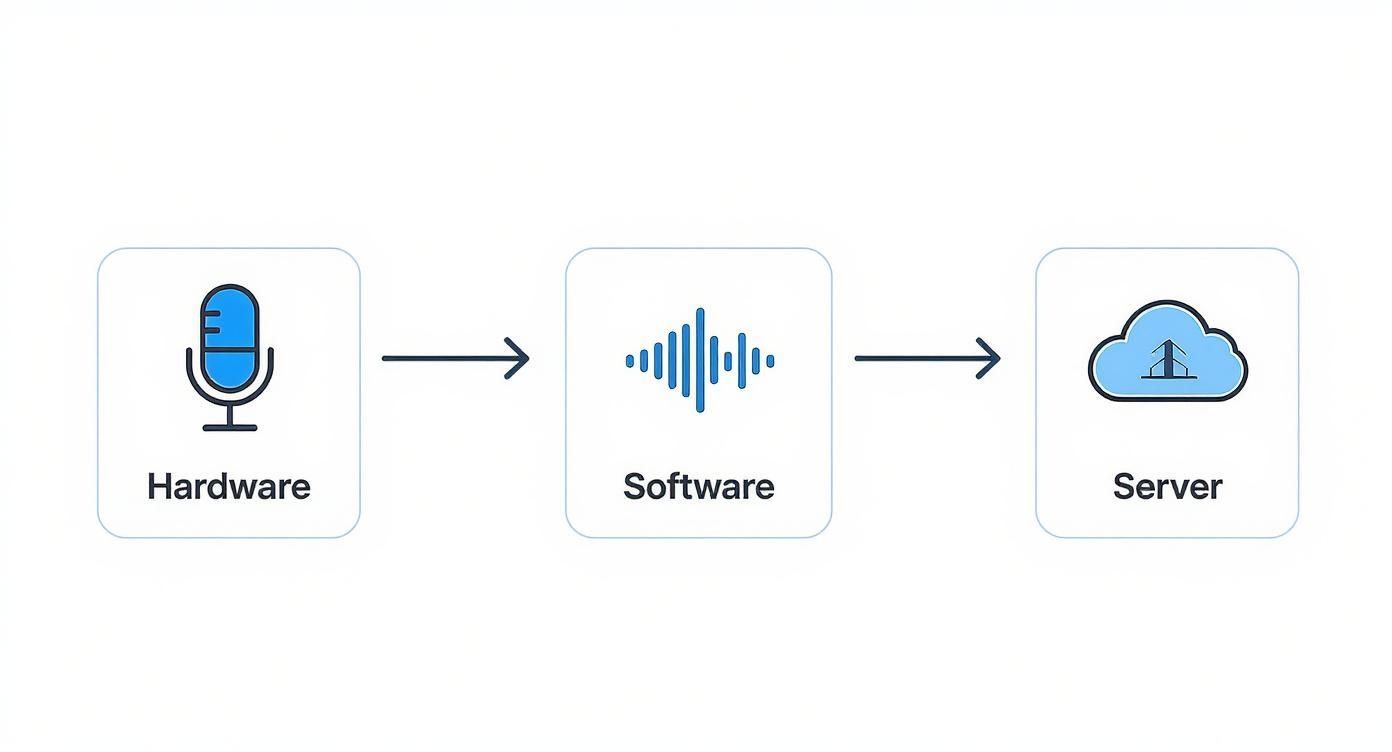
As the diagram shows, a solid server is the heart of your operation, pushing your stream out to your listeners, no matter where they are.
Setting Your Broadcast Destinations
Once your encoder is successfully sending your stream to the server, you get to decide where people will actually tune in. My advice? Don't put all your eggs in one basket. Spreading your stream across multiple platforms is the smartest way to grow.
Your Website and Radio Directories
Your website is your home turf. Your streaming provider should give you a simple HTML5 web player that you can just copy and paste right onto your site. It’s the most direct way for your audience to connect with you. Beyond that, be sure to submit your station to popular internet radio directories like TuneIn and Streema. It's a low-effort way to get discovered by people who are actively looking for new music.
Broadcasting a 24/7 Live Stream to YouTube
If you're serious about growth, you can't ignore the massive potential of a 24/7 live stream on YouTube. Your server can easily push your audio to YouTube using an RTMP feed. All you have to do is grab the stream key from your YouTube Live Studio and plug it into your server settings.
By maintaining a constant RTMP stream, your channel stays live on YouTube 24/7. This is a huge advantage for discoverability. The YouTube algorithm loves long watch times, and a continuous broadcast helps you rack them up, boosting your channel in search results and recommendations.
You don't need a fancy video—just your audio paired with a static image or a simple visual loop is more than enough to create a powerful presence. And if you want to get really ambitious, you can check out our guide on how to stream to multiple platforms at once to learn how to hit YouTube, Twitch, and other sites all at the same time.
Fine-Tuning Audio Quality and Metadata
Let's wrap up with the final touches that make your station sound truly professional. There are two quick settings you’ll want to get right.
The first is your bitrate. This directly impacts your audio quality. From my experience, a bitrate of 128 kbps AAC is the sweet spot for most music formats. It delivers crisp, clean audio without being too data-heavy for listeners on mobile devices. If you're broadcasting in MP3, 192 kbps is a solid choice.
The second is your metadata. This is the artist and song title information that shows up in the player. Your automation software can handle this automatically, pulling the info from your audio files and sending it with the stream. Getting this right is a small detail that makes a huge difference—it looks professional and lets your listeners know exactly what they're hearing on your 24/7 stream.
Growing and Monetizing Your Audience
Getting your station on the air is a fantastic first step, but the real work starts now. It's time to shift your focus from the technical setup to building a loyal community and, eventually, turning your passion into a sustainable operation.
Finding Your Tribe and Spreading the Word
Your station won't grow on its own—you have to get out there and find your listeners. The best place to start is where they already hang out online. Figure out which social media platforms fit your station's vibe and build a genuine presence there.
Don't just post links to your stream. Share behind-the-scenes moments, tease upcoming shows, and chat with people who comment. This isn't just promotion; it's community building. You're creating a feedback loop that turns casual listeners into die-hard fans.
An email newsletter is another must-have. Think of it as your direct connection to your most dedicated supporters, perfect for sharing weekly schedules or exclusive content. All these efforts are designed to drive people back to your stream, especially if you're running a 24/7 live stream on YouTube where consistent viewership really matters.
From Listeners to Revenue
Once you've got a dedicated audience, you can start thinking about money. While you could just run traditional ads, the most successful 24/7 streams get creative and find ways to earn that feel natural to their brand.
Here are a few proven ideas that work well:
- Direct Listener Support: Platforms like Patreon make it easy for your biggest fans to chip in a few bucks a month. On YouTube, you can use features like Super Chat during premieres or special events on your 24/7 stream.
- Branded Merch: T-shirts, mugs, stickers—you name it. Selling merch not only brings in cash but also turns your listeners into walking advertisements for your station. It’s a win-win.
- Sponsored Content: Instead of disruptive ad breaks, find brands that your audience would actually like. You could partner with them for a "sponsored hour" of commercial-free music or a sponsored segment within a talk show.
The global internet radio market is on a serious growth trajectory, expected to jump from $3.22 billion in 2025 to $5.82 billion by 2030. This boom means there's a huge opportunity for stations with smart, modern advertising and diverse income streams. Discover more insights about internet radio market growth on Mordor Intelligence.
To build something that lasts, you need a solid business plan. For some great ideas on building a business around audio content, check out this guide on how podcasters make money. When you put your community first, you'll find that making money becomes a natural next step, not a forced one.
Got Questions? Let's Get Them Answered
Diving into the world of internet radio always brings up a few common questions. Let's tackle some of the big ones so you can move forward with confidence.
Can I Really Get on the Air for Free?
It’s a classic “yes and no” situation. You can definitely get started with almost no money down by using free broadcasting software and sticking to royalty-free music. That lets you sidestep the big licensing fees, at least initially.
But if you're serious about running a station that’s live 24/7, you'll need to pay for a solid streaming host. It's a recurring cost, but it's the bedrock of your station's reliability and reach. Think of it less as an expense and more as an investment in a continuous stream people can count on.
What's the Real-World Cost for Music Licensing?
This is where it gets tricky because the price tag can swing wildly depending on where you are and how many people are tuning in. For a small station in the US, a blanket license from a major performance rights organization (PRO) like ASCAP or BMI might start at a few hundred dollars a year.
The catch? To be fully covered for all the music you want to play, you usually need licenses from several different PROs. A safe bet is to budget somewhere in the $1,000 to $2,000 range annually just to get started with commercial music for your 24/7 stream.
Do I Need a Supercomputer to Broadcast All Day?
You'd be surprised, but no. A regular, decent computer is perfectly fine for setting everything up and managing your playlists. The real pro move for a 24/7 broadcast is to offload the heavy lifting to a cloud server.
This means your station is actually running from a secure, professional data center, not your home office. Your stream stays live and steady, even if your power goes out or your cat unplugs your laptop.
When it comes to a flawless 24/7 broadcast, the power of your personal computer is secondary. What truly matters is the reliability of your cloud hosting. That's what keeps your stream from dropping and builds the kind of trust that grows an audience, especially on platforms like YouTube.
This is the secret sauce when you want to start an internet radio station that's built to last.
Ready to launch a professional, always-on broadcast without the technical headaches? 24/7 LiveStream provides the ultimate cloud-based solution to run a continuous live stream on YouTube and other platforms effortlessly. Set it up once and let our reliable servers keep you live 24/7. Start building your audience today at https://247livestream.live.